
The End of Coding? Why Manual Programming is a Legacy Skill in 2026
Business News Today: The year 2026 is a turning point in history in the technological field. Over the decades, the ability to write syntactic code by hand in programming languages such as Python, Java or C++ was the gateway to a career in technology. Nevertheless, with the mid-decade, the industry is experiencing a Great Decoupling. Software is as highly valued as it has never been before, but the art of coding is taking a back seat, almost a secondary skill.

 Share
Share
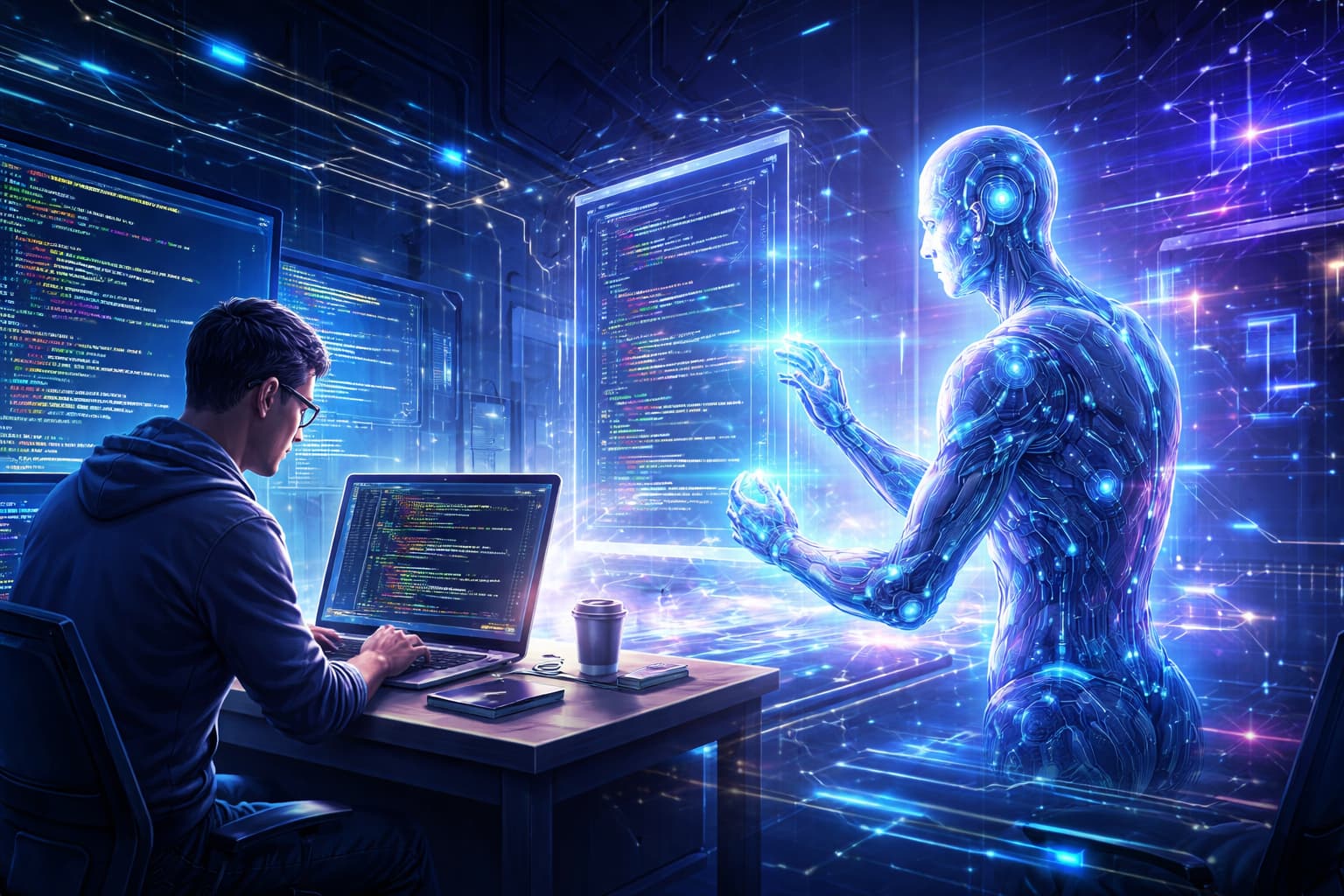
With the development of generative models into autonomous agentic systems, the software development lifecycle (SDLC) has been flipped upside down. We are now no longer in the age of the so-called Copilots suggesting the next line; we are in the age of the so-called Engineers, who organize the fleets of the AI agents to construct, test, and implement complex systems.
The Shift from Manual Coding to AI Orchestration
The measures of an effective developer have changed in 2026. Recent industry data says that about 46% of all new production code in the world is now being generated by AI. This has turned the everyday life of a software engineer upside down. The modern professional does not sit and stare at a blank IDE (Integrated Development Environment) but rather begins with a high-level architectural prompt or a vibe coding session where the AI is able to scaffold both the backend and frontend in a couple of minutes.
The fall of manual coding is not merely about speed, but about creating democratization. The barrier between an idea and working applications has practically disappeared with natural language programming becoming the standard interface. This change has necessitated a drastic re-thinking of what constitutes being a coder.
Why the Traditional Coder is Being Replaced
The shift has not been a slow-fade but a fast displacement driven by 3 fundamental pillars of technology:
- Autonomous Agentic Workflows: AI agents do not write functions in 2026; they comprehend repositories as a whole. They are able to plan multi-file modifications, perform intricate refactoring and solve dependencies automatically.
- The Rise of Low-Code/No-Code Ecosystems: The market around these solutions has grown to exceed $50 billion, with non-technical stakeholders able to create enterprise-scale tools that used to take ten people.
- Error-Correction and Self-Healing Code: AIs now have loops of reflection: they run their own code, discover bugs, fix them before a human has even logged into the pull request.
- Architectural Synthesis: The emphasis has shifted away to how to write a loop to how* to tie a distributed system together. The developers now become system architects and not syntax oriented but data flow and security oriented.
The Survival of the “Product Engineer”
As the art of typing code is becoming extinct, the need of Software Engineers with the knowledge of the wider Business picture is stronger than ever. In 2026 companies are not seeking syntax experts; they are seeking problem solvers that are able to convert a complicated commercial need into a technical approach that can be implemented by AI.
This development has resulted in a Trust Gap. Although AI can generate code on a scale never seen before, it is not very good at deep architectural reasoning and long-term maintainability. Studies indicate that productivity has been improved by more than 55 years, but the probability of AI slop, or unoptimized bloated code, has also increased. Therefore, code curation and deletion is in fact the most valuable skill in 2026. Engineers have become Janitors of Code, cleaning up the extra that AI creates to provide the system with a lean and safe state.
The New Talent Landscape: Prompting over Programming
To the new entrants, the roadmap is different. Colleges have redefined Computer Science courses to abandon Intro to C++ and adopt AI Orchestration and Prompt Engineering. It is now concentrated on:
- System Design: Understanding how various microservices and APIs interact.
- Security Auditing: Identifying the subtle vulnerabilities that AI-generated code frequently introduces.
- Domain Expertise: Understanding the specific needs of industries like healthcare, finance, or legal tech.
The history that software is eating the world has been changed: now AI is eating software. The code in itself is now a commodity–disposable, cheap as well as abundant. The true value has reverted to human creativity, strategic thought and the capacity to control the robots who do the heavy lifting. In 2026, when you are still only writing code, you are not a developer, you are a legacy system.
Related News

Jan Dhan Yojana Crosses 58 Crore Accounts, Boosting Financial Inclusion in India
Business News Today: India has had the occasion to observe history being made as the Pradhan Mant...

SEBI Bans Rajesh Exports CMD Over Alleged Financial Irregularities
Business News Today: SEBI hit the Chairman and Managing Director of Rajesh Exports with hefty fin...
Byju’s Tragedy: How Absolute Success Ruined a $22B Empire
Business News Today: Byju’s is a modern-day corporate tragedy, the rise of the Indian ed-te...