
US–Pakistan Tensions Rise Over Reported Abraham Accords Call Dispute
Latest World News: The recent events have caused an uproar in the global diplomatic arena due to allegations that Pakistan has turned down the invitation sent out by former President Donald Trump of the United States in an effort to widen the horizon of Abraham Accords initiative amid the present Middle East War Update scenario. While neither the government of Washington nor of Islamabad has made an official announcement regarding the issue, many are speculating about its implications for their diplomatic relations and peace initiatives in the Middle East region.

 Share
Share
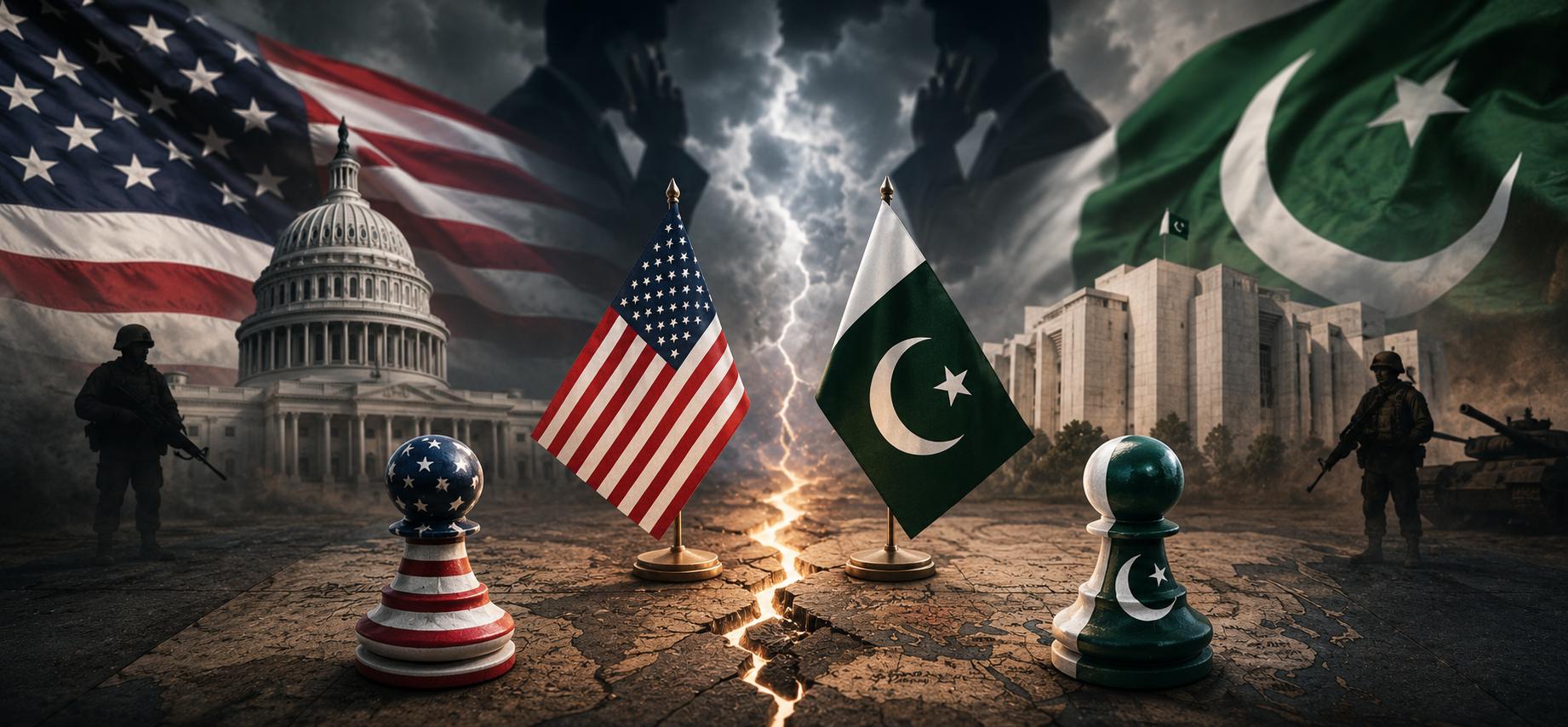
The controversy revolves around the Abraham Accords project, whose main objective is to establish normal diplomatic relations between Israel and some of the Arab nations. While there have been news reports about the possibility of extending the project’s scope to include other countries with Muslim majority populations, the reported reaction of Pakistan raises concerns about the relationship between the two countries in the future in respect to diplomacy, trade, and security issues.
The background of the Abraham Accords and US–Pakistan Relations
The Abraham Accords, launched during the presidency of Donald Trump, were a big turning point in Middle East diplomacy as Israel and the UAE, Bahrain, Sudan and Morocco have signed a normalization agreement. It was seen as a keystone of Trump’s foreign policy, intended to redefine regional partnerships and ease centuries-old tensions.
However, Pakistan has traditionally taken a cautious approach toward normalization with Israel, due to the unresolved Palestinian issue. This role has repeatedly been a determining factor in Islamabad’s diplomatic choices and the way it has interacted with wider peace processes led by the United States.
Some factors that are important in context are:
- Strategic relations between the U.S. and Pakistan, which have been in place for a long time and are connected to security cooperation and counterterrorism.
- Pakistan’s steadfast stance for two-state solution in Palestine
- Concerns over domestic political sentiment on normalization with Israel
- The shift in Washington’s strategies for opening up Abraham Accords involvement
- The Middle East and South Asia are home to competing regional alliances.
Nevertheless, if Pakistan sees the broadening of Abraham Accords as an insult, then there seems to be little that is out of the ordinary for analysts to see in this matter, considering other current issues like the Balochistan Unrest.
Reported Response and Diplomatic Interpretations
In an attempt to convince Pakistan to join the discussions associated with an expanded Abraham Accords framework, the allegation is that the country was patched or “shot down” by Pakistan.During a diplomatic tussle regarding political outreach from the United States, it was reportedly shot down or dismissed by Pakistan. There have not been official announcements made about such an event, however.
The key points of the alleged reaction
- Pakistan’s diplomatic efforts apparently repeated the previous policy of non-recognition of Israel without a Palestinian solution.
- Some policy observers reportedly found the proposed scaling up of the Abraham Accords too early.
- US diplomatic efforts might have been directed at broader regional integration with other Muslim majority countries.
- No formal announcement or verified transcript of the alleged call has been made public
- Political analysts warn against taking things for granted pending official confirmation.
In the wider world diplomatic landscape, the above areas each show the importance of the topic and the need to separate fact from speculation in news reports.
The international strategic and diplomatic consequences
If it is a diplomatic exchange, it could have consequences for bilateral relations as well as others. The Abraham Accords, which are part of the new geopolitics of the Middle East region, may also continue to influence the future course of relations, while resistance from countries like Pakistan, which are important Muslims, may affect the future course of expansion.
On a wider scale, it involves much more than a few issues that could be considered international:
- Middle Eastern and South Asian changing alliances
- U.S. diplomacy as a mediator of regional peace agreements.
- Balancing economy with ideology
- Increased contestation of influence among major powers.
- Increased contestation of influence among major powers.
- Domestic political sensitivity of public opinion
Conclusion
There are reports of Pakistan’s response to an outreach from Donald Trump related to the Abraham Accords, but without official confirmation, it remains unclear. However, the dialogue underscores current tensions in U.S.-Pakistan relations and difficulties of extending peace agreements into politically sensitive areas.
With the ongoing evolution of international diplomacy, the normalization process, Middle East stability, and strategic partnership negotiations will remain key components of international policy discussion. For now, all is speculation from both sides as to what signals are being sent by Islamabad and Washington before they can come to a conclusion.
Also Read: UK Man Jailed for 5 Years Over Antisemitic Threats Near
Related News
Ancient Ruins Revealed: The 1967 Search for a Haunting Bronze Age City
Latest World News: In 1967, a truly groundbreaking find emerged that revolutionized our knowledge...

Nepal Border Shock: PM Balen Shah’s Controversial Claim Rocks Ties
Latest World News: A major political storm has broken over Kathmandu, the capital of the Himalaya...
Netanyahu vs Trump: The Explosive Lebanon Clash That Changed the War
Latest World News: A serious diplomatic rift has now opened up between Washington and Jerusalem f...