
How Newton and Leibniz Split the Mathematical World
Newton vs Leibniz: The modern school environment teaches calculus as an essential branch of mathematics, regardless of its complexity. The symbols that are commonly used by students in solving complex problems with regard to change and motion include the integral sign and the notation dy/dx. However, behind these equations is one of the most bitter and prolonged scientific controversies. In the course of several decades, Sir Isaac Newton and Gottfried Wilhelm Leibniz were involved in a so-called Calculus War that disunited the European scientific community and re-shaped the history of mathematics.

 Share
Share
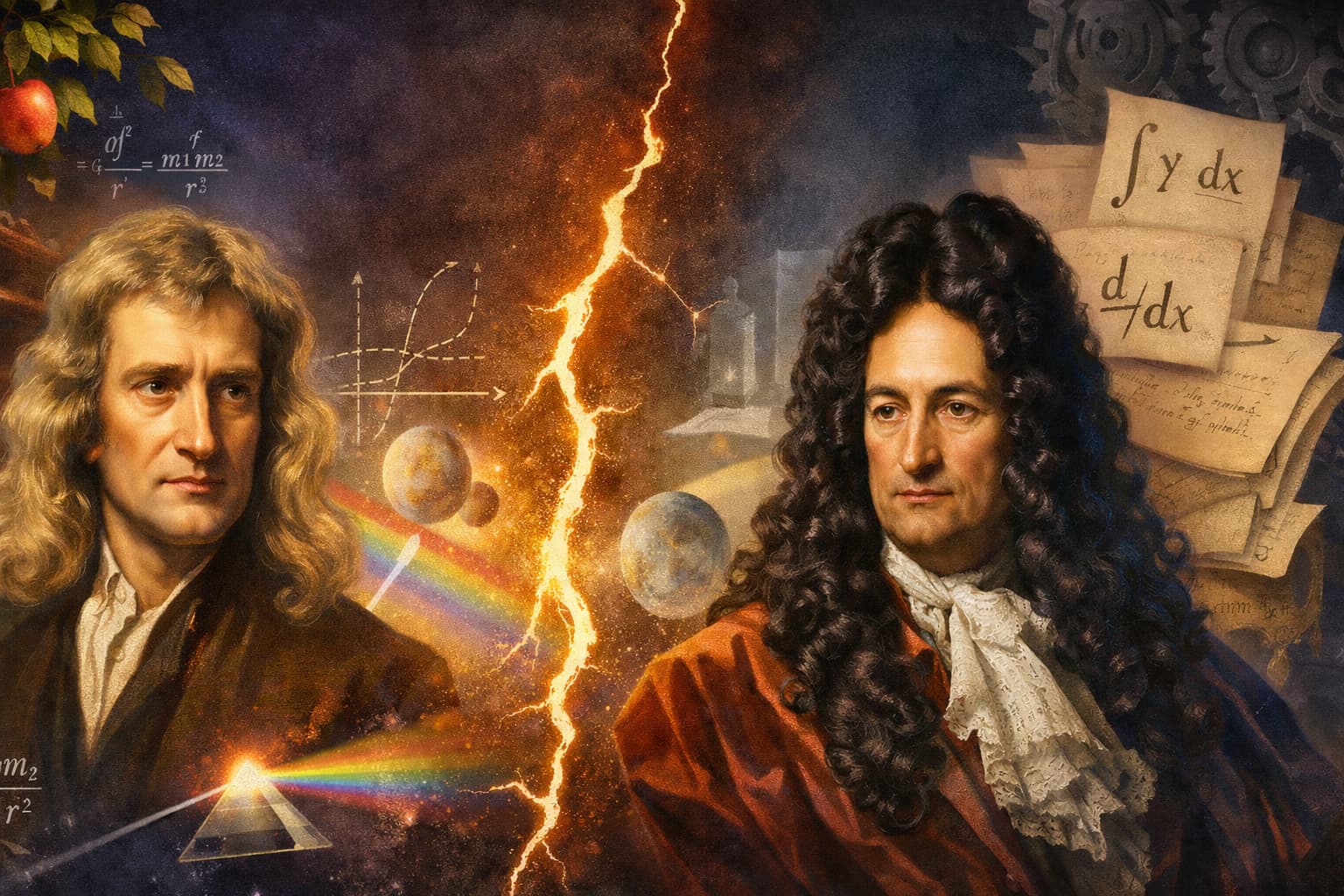
Two Paths to One Discovery
This latest education news is based on the issue of who initially developed the mathematics branch that allows the determination of rates of change. The development of his form of calculus, which he called the method of fluxions, began in the mid-1660s with Sir Isaac Newton, the outstanding English physicist, discoverer of the laws of motion and gravity. During the Great Plague of London, Newton worked more or less entirely alone and used his new mathematics to explain planetary orbits and the workings of the natural world.
Although Newton was the first to have the thoughts, he was notorious about sharing his discoveries. He distributed his findings only by private correspondence and manuscript only to a small group of colleagues. On the other side of the English Channel, the German philosopher Gottfried Wilhelm Leibniz began his own mathematical investigations in the 1670s. Leibniz, in contrast with Newton, immediately transferred to publication. In 1684, he published a paper where he defined his version of the differential calculus, followed 2 years later by one on the integral calculus.
Also Read: Why Richard Feynman Preferred Doubt Over Wrong Answers
The Accusations Begin
The conflict did not break out immediately. Throughout the years, the two men seemed to admire one another’s works. The situation, however, worsened when the followers on both sides started becoming doubtful of the novelty of the discoveries. Since Newton had recorded his techniques in secret letters long before the publication of Leibniz, it seemed to the disciples of Newton that Leibniz had made use of those letters and stolen the ideas.
Leibniz, nevertheless, held that this was a purely independent method. Whilst Newton focused on the physical uses of the concept of motion and time, Leibniz took a logic-based approach to the issue and was looking to find a universal language by which to explain the relationship between quantities. He even created a complex system of notation, the very symbols which we use today, to make mathematics more accessible and regular.
Get the Latest Education News in India at DailyInfo
A Rigged Investigation
By the early 18th Century, the conflict had gone out of control into an international scandal. A committee was then appointed in 1711 by the Royal Society of London to investigate the claims of plagiarism. At this point, Sir Isaac Newton was the president of the Royal Society.
By presiding over the investigation of his own case, Newton in effect took over a case that was a matter of huge conflict of interest under modern terms. He appointed the members of the committee as he pleased and even wrote the final report and published it anonymously. Not surprisingly, the report announced Newton as the true inventor and Leibniz as a wilful concealer. Leibniz never received a chance to tell his side of the story to the committee.
The Lasting Impact
The consequences of this competition were high. Loyalty to Newton led the British mathematical community to continue to use his dot notation, which was cumbersome and hard to use when dealing with more complex problems. Mathematicians on the European continent, in contrast, followed a more liberal notation of Leibniz. This gave rise to a mathematical schism that stifled the development of England for almost a century.
It has been history that has at last done justice to both men better than they had deserved to one another. There is a general agreement between modern historians and mathematicians that both Newton and Leibniz independently discovered calculus. Leibniz provided the world with the background and the codification of mathematics that could be used by the masses, yet Newton might have already had the idea in his mind. The so-called Calculus War reminds people today that even the most geniuses cannot withstand the ego and the urge to get fame.
Also Read: Afraid of Chemistry? The Subject is Not to Blame Perhaps
Related News

Pythagoras’ Wisdom on ‘Yes’ and ‘No’ Resonates Today
Latest Education News: The Quote of the Day is often a rather compact information source that she...

Carl Sagan’s Vision of Science as a Spiritual Path
“Science is not only compatible with spirituality; it is a profound source of spirituality....

Lucknow Teenager Kills Father Over Academic Pressure
Latest Education News, LUCKNOW – There is an ugly instance of a patricide that shook the Vikas Na...