
Blinkit and Others Drop Speedy 10 Min Delivery Branding
In a major change in the fast-core business of the Indian quick-commerce, Blinkit has officially taken off the well-known 10-minute delivery pledge as part of its branding. The relocation follows the intervention of the Union Ministry of Labour and Employment to respond to the increasing issues of safety and well-being of the thousands of delivery partners who drive these platforms.

 Share
Share
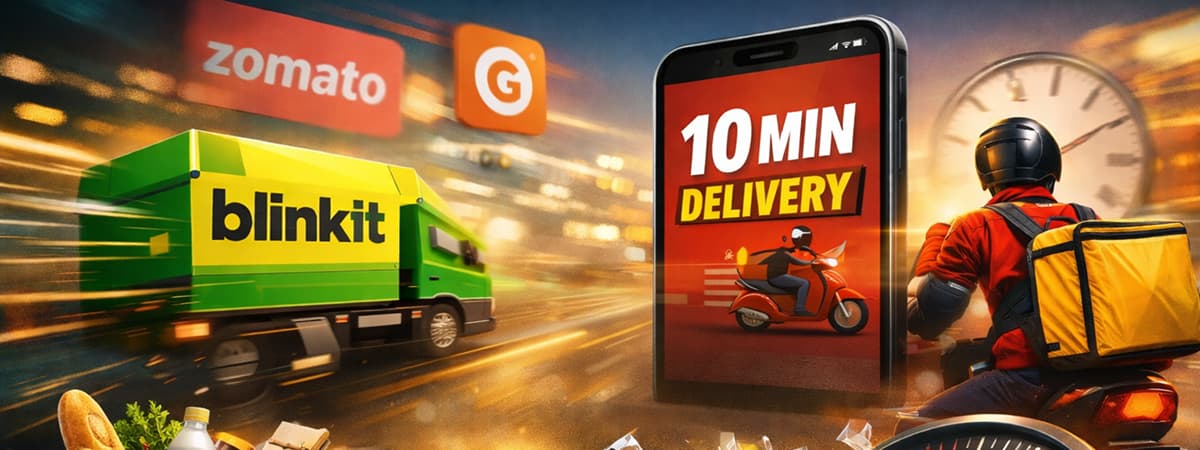
This business news today signals the conclusion of the hyper-competitive speed wars that characterized shopping in urban India in the past few years. Although the 10-minute tag was a huge success among the consumers who need to have immediate gratification, it had become a thorn in the flesh between the companies, their employees, and the government.
Is the 10-Minute Delivery a Myth?
The model has always been defended by its eternal CEO, Deepinder Goyal, who has stated that the speed is due to the density of the dark store and not rider speed.
The reason is simple: when a warehouse is within 2 kilometers of your home, it is possible to find a rider who travels at a safe speed of 1520 kmph and arrives on time within 10 minutes. Goyal has explained that riders do not even have a timer on the apps.
But according to the government, popular marketing of such time-limited products is reckless. It somehow creates expectations that do not consider the “real-life factors” such as traffic congestion or building works, and puts the rider at a disadvantage to compensate for the wasted time on the road.
The Government Steals the Show
Recently, the Union Labour Minister Mansukh Mandaviya conducted a set of meetings with leading executives of key competitors, such as Blinkit, Zepto, Swiggy, and Zomato. In such sessions, the ministry established its position quite clearly that, as much as innovation is welcome, it is not at the expense of human life or dignity.
According to government sources, the minister has convinced these aggregators to review their predatory marketing. The initial concern was that the 10-minute clock caused great psychological and physical pressure to the riders. The fact that the companies did not necessarily punish a late delivery, but the culture of hurrying through traffic and disregarding safety rules to fulfill an unrealistic promise, continued to promote such behavior in the branding.
Protests and Pressure
The breaking point in this intervention was a countrywide strike by gig employees on New Year’s Eve in 2025. Thousands of delivery partners declined to log in, complaining of declining incomes and the stressful atmosphere of ultra-fast delivery models.
The 10-minute model has long been held by worker unions as forced labor in disguise, like the Telangana Gig and Platform Workers Union (TGPWU). They added that riders are frequently forced to take up broken roads, downpours, and traffic jams, and that they do so with a timer on the customer screen running down.
The move by the government was welcomed by AAP Rajya Sabha MP Raghav Chadha, who has been a strong advocate of the riders. He observed that, in the case of the rider wearing a T-shirt on which he has the numbers 10 minutes printed, the pressure becomes real, constant, and dangerous. He termed the abolishment of the branding a triumph of human dignity.
New Look, New Promise
Blinkit is a company belonging to the Eternal Group (previously Zomato), and the first to blink. The famous slogan of its brand, which once promised 10,000+ products and delivery within 10 minutes is changed, unobtrusively. The new motto now goes like this: 30,000+ products delivered to your doorstep.
The company is making an attempt to shift the value proposition by turning the emphasis from how fast to how much. According to industry observers, Swiggy is likely to be followed by Instamart and Zepto in the next few days, scrubbing their apps and adverts of such time-bound assertions.
What Changes for the Customer?
This may not make much difference to the average shopper in the actual sense of the service. You could still receive your milk and the bread in 8 or 12 minutes if you live close to a warehouse. The difference will be the guarantee. It helps in stabilizing the expectation of customers and minimizing the chances of complaints when a 15-minute delivery is made instead of a 10-minute delivery.
For the latest business news daily, keep visiting daily info.
Related News

₹590 Crore Government Fund Fraud
Business News Today: A major financial scandal of ₹590 crore of embezzlement of Haryana governmen...

Uber to Launch Electric Air Taxis
Business News Today: The dream of driving over the overcrowded traffic in the cities is becoming ...

Fast Fashion Takes Small-Town India by Storm as Zudio Hits $1 Billion Revenue
Business News Today: The structured budget fashion industry in India has come to a historic cross...