
Indian Rupee Hits 94 Against US Dollar: Record Low Marks Worst Yearly Fall in 10 Years
Latest Business News: The Indian rupee has fallen below the 94 mark against the US dollar, and it is its lowest fiscal year of decline over 10 years. This drastic depreciation has drawn the attention of the policymakers, investors and businesses because it is a domestic issue as well as an international financial problem. The depreciation of the currency reveals a mix of increased importation bills, capital flows and hegemony of the US dollar in the foreign exchange markets.

 Share
Share
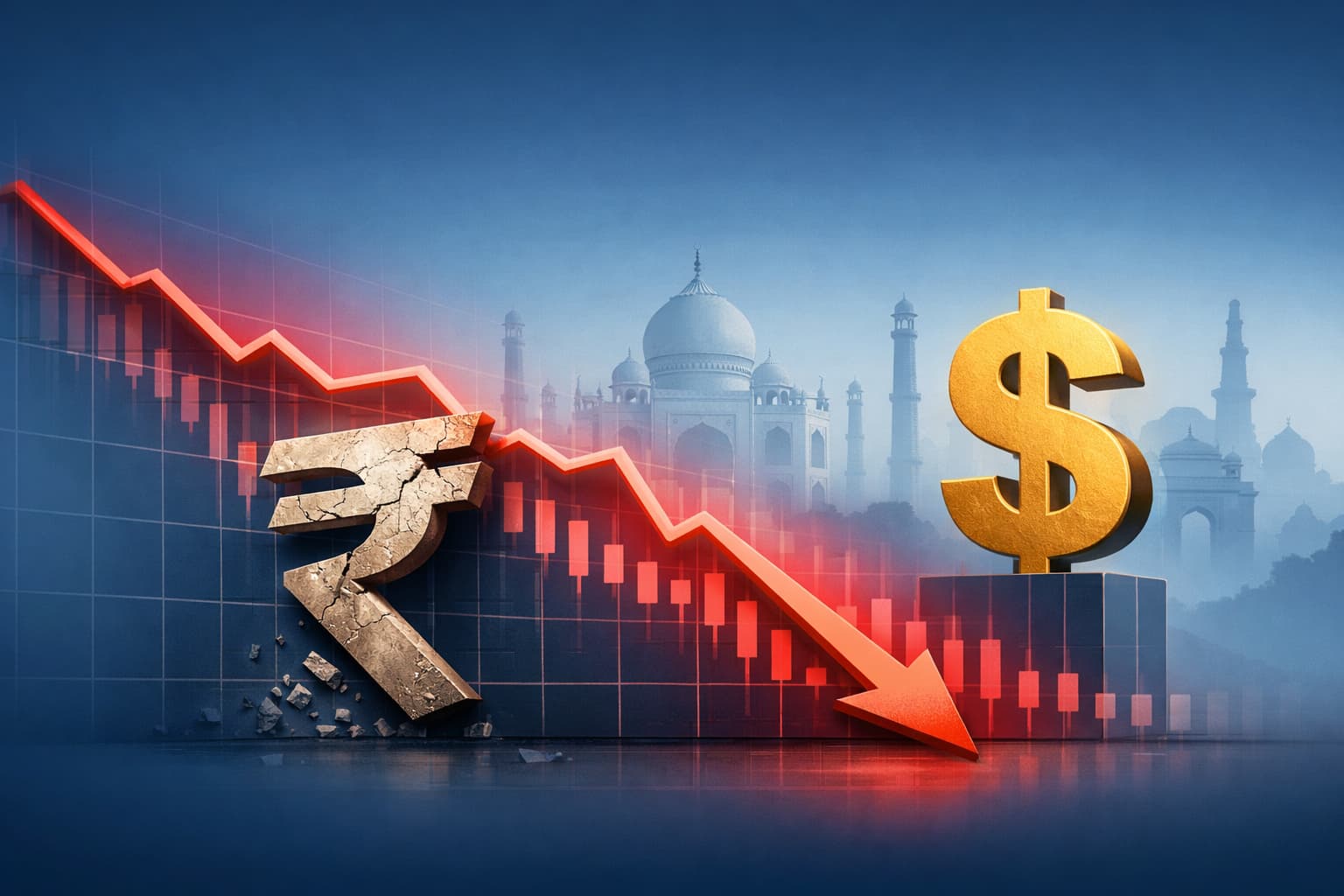
Depreciation of the rupee has progressed slowly during the fiscal year but has been accelerating over the last few months because of the continuous inflationary pressure, geopolitical uncertainty, and increasing concerns in the Business sector. Monitoring of the situation has been actively taken by the Reserve Bank of India (RBI) which has intervened in the currency markets where it was considered to be too volatile.
Key Reasons Behind the Rupee Fall:
The reason why the rupee has fallen drastically this fiscal year has been attributed to a few factors:
- Strong US Dollar: Due to the persistence of the US dollar, the emerging market currencies, such as the rupee have been weaker by comparison.
- Increase in the Crude Oil Prices: India is a big importer of oil and as the prices of oil go up, it puts pressure on the trade balance.
- Foreign Capital Outflows: International investors have diverted to the security of other assets and they have resulted in outflows of capital in Indian markets.
- Trade Deficit Expansion: Consumption in terms of imports has increased more than exports and this has decreased the current account deficit.
- World Geopolitical Uncertainty: The current global geopolitical tensions and declining globalization have also affected the investor confidence.
Impact on Economy and Businesses
The Indian economy is both adversely and adversely affected by the weakening rupee. On the one hand it is advantageous to exporters in that it makes the Indian goods more competitive in the global markets. The IT services, pharmaceuticals, and the textile industries are some of the sectors that could experience better earnings because of the favorable exchange rates.
Conversely, industries that are reliant on imports are more expensive. The industries that depend on the raw materials and machinery or fuel imports are probable to face the pressure of the margins. Moreover, increased importation expenses are also a contributor to inflation which may also have a direct impact on the consumers by bringing their goods and services prices upward.
To ordinary citizens, the effects can be seen in the escalating fuel prices, the high prices of imported commodities such as electronics and the cost of travelling to other countries may be considered to be high. Students and professionals that are exposed to foreign currency payments are also affected by the depreciation.
RBI’s Response and Policy Measures
To stabilize the rupee and secure the market confidence the Reserve Bank of India has done a number of things. These are the sale of foreign exchange reserves to deal with excessive volatility and the adjustment of monetary policies to deal with inflation.
Central bank has also focused on having sufficient forex reserves which provide a buffer in moments of currency stress. Although nothing can be done to ward off depreciation fully, interventions are used to smooth out sharp swings and bring about order in the market moves.
Outlook for the Rupee
In the future, the rupee trend will be determined with respect to a number of domestic and international factors. The rupee is likely to gain some lost ground should the global financial conditions improve and the capital inflows resume. The currency may however, remain strained in the foreseeable future, due to further pressure on the currency by the oil prices and other external uncertainties.
According to economists, structural reforms, export expansion, and checking inflation will stand out as the main success factors to make the rupee stronger in the long run. The direction taken by the policies, the inflation rates, and global activities that affect the currency movement in the entire world will be monitored closely by market players.
To sum up, even though the fact that the rupee has broken the 94 level should be taken as a sign of a difficult period of time, it is also essential to take into consideration the interdependence of the contemporary economies. Currency stability will continue to be a key issue that policymakers will have to manage because India continues to move across the changing economic environment.
Also Read: Indian Rupee declines in foreign exchange markets: Opens ₹93.71 vs US dollar
Related News

Jan Dhan Yojana Crosses 58 Crore Accounts, Boosting Financial Inclusion in India
Business News Today: India has had the occasion to observe history being made as the Pradhan Mant...

SEBI Bans Rajesh Exports CMD Over Alleged Financial Irregularities
Business News Today: SEBI hit the Chairman and Managing Director of Rajesh Exports with hefty fin...

Byju’s Tragedy: How Absolute Success Ruined a $22B Empire
Business News Today: Byju’s is a modern-day corporate tragedy, the rise of the Indian ed-te...