
US Slaps 100% Tariff on Patented Drugs: Is India’s Pharma Business in Danger?
Business News Today: A move that has sparked a huge uproar in the global healthcare industry, the United States administration has officially announced that they have made a decision to impose a huge 100% tax on patented pharmaceutical products. By invoking the Section 232 of the Trade Expansion Act, the United States government has cited the issue of national security and the need for the country to have a home-grown pharmaceutical industry as the key reasons for imposing a huge fiscal disincentive on the industry.

 Share
Share
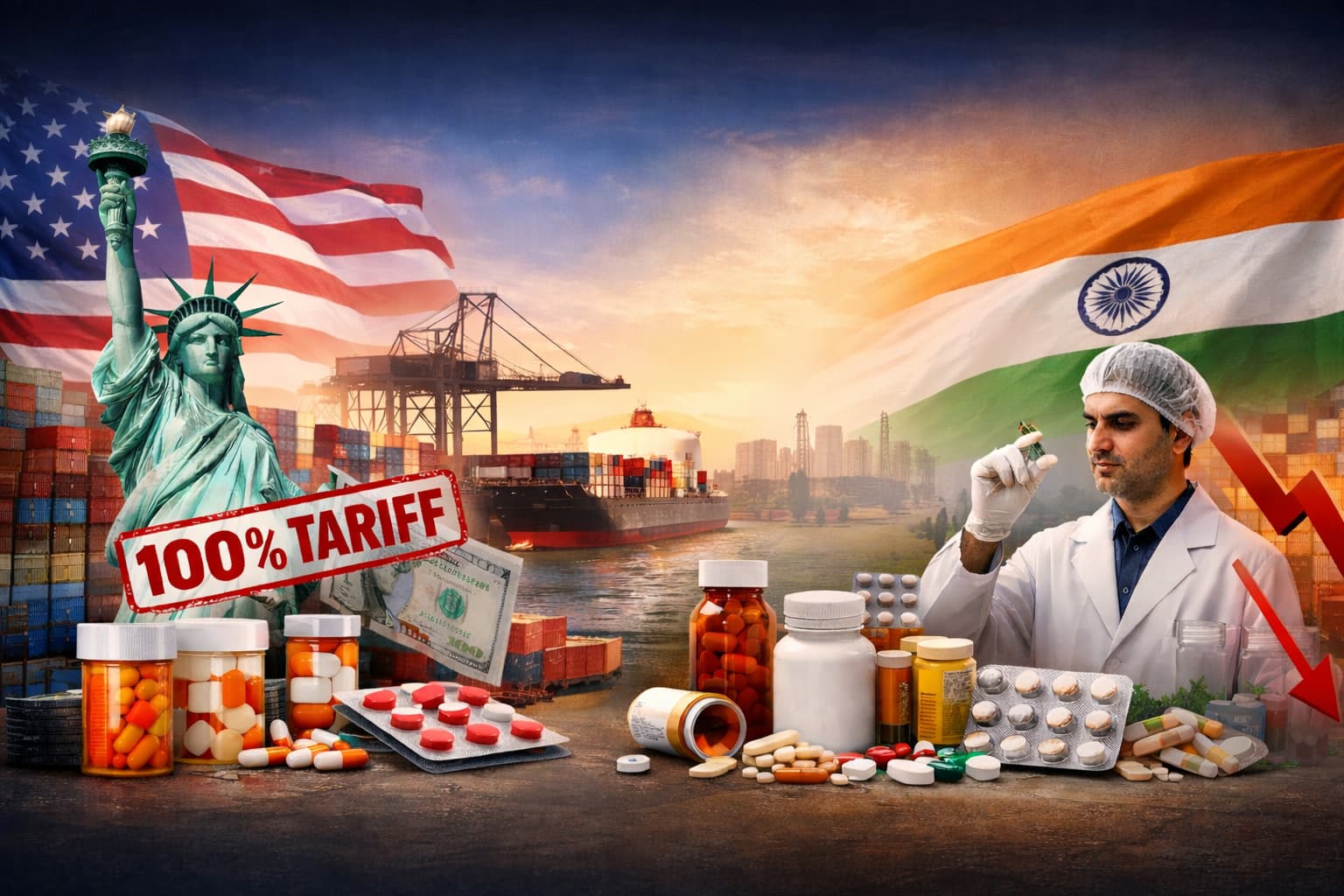
The country of India, which has been referred to as the “Pharmacy of the World,” finds itself at a crossroads with regard to the issue of what the United States administration has decided. Although it has been cited that patented pharmaceutical products are the ones that are to be taxed as opposed to generic drugs, the Indian business environment has already reflected this.
The Immediate Impact: Generics vs. Patented Drugs
The greatest relief for the Indian pharmaceutical industry lies within this proclamation itself. This 100% duty is currently imposed only on patented pharmaceutical products and Active Pharmaceutical Ingredients (APIs). This is a great relief for Indian pharmaceutical companies because Indian pharmaceutical companies have always been at a leadership role in the pharmaceutical industry across the globe because of the cheaper non-branded pharmaceutical products they manufacture.
Key Takeaways for Indian Manufacturers
- Generics Exemption: At present, there is an exemption for generic pharmaceutical products, which constitute 90% of pharmaceutical exports to the U.S. This is a huge cushion for pharmaceutical exports.
- Specialty Portfolio Risk: For pharmaceutical companies like Sun Pharma and Dr. Reddy’s, who have changed their portfolio to ‘specialty’ pharmaceutical products, there is a risk of loss of revenue from the American market.
- The Reshoring Ultimatum: The US government is giving a chance to Indian pharmaceutical companies to reduce this duty to 20% in return for their plans to ‘reshore,’ i.e., shift their manufacturing units to America.
- Phased Implementation: This duty is to come into effect from July 31, 2026, for large-cap pharmaceutical companies, whereas smaller pharmaceutical companies have till September to get accustomed to this scenario.
Market Volatility and Investor Sentiment
The news has led to an immediate reaction on Dalal Street. The Nifty Pharma Index has seen considerable volatility in the day as investors try to balance the “tariff shock” with the stability of the Generics segment. The segment is stabilized; however, there is an overall sense of caution reflected in the high-value segment.
Long-term Strategic and Economic Shifts
- FDI Redirection: Investments originally intended for Indian R&D centers may now be allocated to building U.S.-compliant infrastructure within India to circumvent the tariff barrier.
- Pricing or Production Trap: The U.S. is using the Most Favored Nation (MFN) Pricing benchmarks to provide relief to the Indian pharmaceutical companies with regard to tariffs. The Indian pharmaceutical companies have to make a decision: price or production. The production costs are not affordable for the Indian pharmaceutical companies.
- Supply Chain Redirection: The Indian pharmaceutical companies are now forced to look for alternative raw material sources within India or the U.S.-approved nations to avoid the imposition of secondary tariffs.
- Policy Volatility: The White House has issued a statement that the exemption for the Generics segment is only for a year. The Indian pharmaceutical companies have a “Sword of Damocles” hanging over their heads.
Navigating a Protectionist Future
Apart from meeting immediate requirements, it seems that a change in the current global protectionism is in the offing. The U.S., by striking at the supply chain of the pharmaceutical industry, is forcing a change in the traditional globalization of the pharmaceutical industry. It could also mean a decrease in capital spending in India, as the focus would be on localizing the industry in the biggest export market.
The industry leaders are cautiously optimistic but want a degree of diversification. The U.S. Trade Representative is closely monitoring the ‘reshoring’ of essential medicines. If the Indian pharmaceutical industry fails to overcome the hurdles placed by the U.S., then it would not be competitive in the most lucrative healthcare market in the world. The days of low-cost production as a strategy could be coming to an end, and a complex scenario of localized production and pricing could be around the corner.
Also Read: Indian Rupee declines in foreign exchange markets: Opens ₹93.71 vs US dollar
Related News

Jan Dhan Yojana Crosses 58 Crore Accounts, Boosting Financial Inclusion in India
Business News Today: India has had the occasion to observe history being made as the Pradhan Mant...

SEBI Bans Rajesh Exports CMD Over Alleged Financial Irregularities
Business News Today: SEBI hit the Chairman and Managing Director of Rajesh Exports with hefty fin...

Byju’s Tragedy: How Absolute Success Ruined a $22B Empire
Business News Today: Byju’s is a modern-day corporate tragedy, the rise of the Indian ed-te...