
Quality Gap in India’s Academic Textbooks
Latest Education News: To millions of students across India, a textbook is not just a simple educational tool. In many rural and semi-urban areas, it will be the main, and sometimes the only, source of information. However, a growing body of evidence shows that the same tools that were supposed to serve as a guide to the next generation are carrying mistakes, outdated ideas, and poor pedagogical structures.

 Share
Share
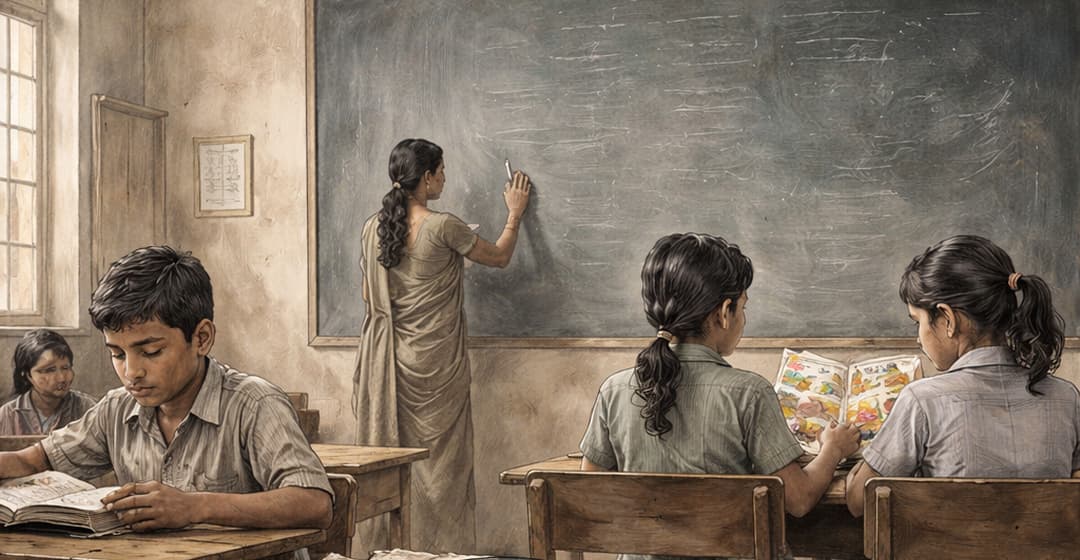
As a result, the standards of academic textbooks have become a very daunting challenge to the quest to modernise the Indian education system.
A Foundation Built on Errors
The most pressing Education News in India, raised by both educators and parents, is the rampant presence of factual inaccuracies. Whether it is the false listing of historical dates or the scientific theories that are mentioned using fallacious reasoning, such misguiding information not only falsifies but also undermines the integrity of the whole educational system. When a student discovers that one of their books was erroneous in a government-approved book, this creates a feeling of doubt in the curriculum.
It is not very unusual to find maps that falsify the geopolitical frontiers or science chapters that ignore a decade of technological advancement. Social-science textbooks have, in other cases, received criticism as perpetuating retrogressive stereotypes or biased histories. Although the National Council of Educational Research and Training (NCERT) revises its content on a regular basis, the mechanism of distributing the new changes to state boards and privately published magazines is slow and not uniform.
Linguistic Hurdles and Translation Issues
Other than the factual accuracy, the language of the books is a significant source of disagreement. India is a polylingual country, and most of the textbooks are translated into local languages. Unfortunately, such translations are often left to bureaucratic committees rather than to linguistic and subject-matter experts.
The result is a text that is usually very cumbersome to read. The scientific language is occasionally translated into some obscure academic forms of local languages that are not used by students in their normal lives. Instead of making the subject, the language is used as an obstacle. This forces the students to memorise things through rote learning, that is, by heart, without having really grasped the concept behind it, as the prose is too convoluted to understand.
The Conflict Between Profit and Pedagogy
The Indian publishing industry is a large one, serving thousands of schools that do not use state-published books. Although there are high standards of some of the privately published ones, a considerable portion of the market is flooded with unworthy content. Such books often put more emphasis on glossy covers and colour illustrations rather than on the strict content.
In many situations, schools conclude unofficial deals with publishers according to which particular collections of books are utilized, and it is very expensive for parents. Since not all the time the selection is done on merit, publishers have little incentive to invest in high-quality editorial staff or professional peer reviews. Such commercialisation of school resources has resulted in a scenario whereby the emergence of a book is more important than the nature of the information held in the book.
The Impact on Competitive Excellence
India has a very competitive entrance examination, including the JEE and NEET. The difference between the quality of standard school textbooks and the level of knowledge needed to pass such exams is enormous. Students often discover that school books do not give them much insight or problem-solving models to succeed in national events.
This gulf has given rise to a multi-billion-dollar coaching business. Textbooks fail to provide a strong background, and as a result, students have to find additional education. This places an unnecessary financial strain on the families and creates a gap between individuals who have money to spend on extra help and those who have to use only the school-provided books.
The Road to Reform
The National Education Policy (NEP) 2020 has provided a very ambitious outline of how Indian children are to be transformed in terms of learning. It gives more focus on critical thinking rather than rote learning and suggests a looser curriculum. Nonetheless, the achievement of NEP is still very dependent on the quality of the books printed with the new National Curriculum Framework (NCF).
The solution to this evil of bad textbooks, it is argued by experts, lies in an increased openness of review. This would entail the participation of the active teachers who are currently in the classrooms in the writing process, and not just depending on retired academics or bureaucrats. Digital integration is also being called upon, as textbooks may be corrected in real time through the QR codes and may deliver updated information.
Also Read: PPC 2026: PM Modi to Interact with Students Live Tomorrow
Related News

Pythagoras’ Wisdom on ‘Yes’ and ‘No’ Resonates Today
Latest Education News: The Quote of the Day is often a rather compact information source that she...

Carl Sagan’s Vision of Science as a Spiritual Path
“Science is not only compatible with spirituality; it is a profound source of spirituality....

Lucknow Teenager Kills Father Over Academic Pressure
Latest Education News, LUCKNOW – There is an ugly instance of a patricide that shook the Vikas Na...