
Indian Markets Bleed as West Asia Conflict Escalates
Stock Market in India: On Monday morning, there was a strong sell-off in the Indian financial markets with the geopolitical tensions in West Asia becoming more pronounced during the weekend. Early trading saw the indexes of the benchmark dropping significantly, and it indicated the great caution of the investors as far as the stability of the region and the world’s energy resources is concerned. The rupee also declined on a very significant level against the U.S. dollar, to new lows, with capital outflows shifting to the security of other assets.

 Share
Share
Panic Selling on Dalal Street
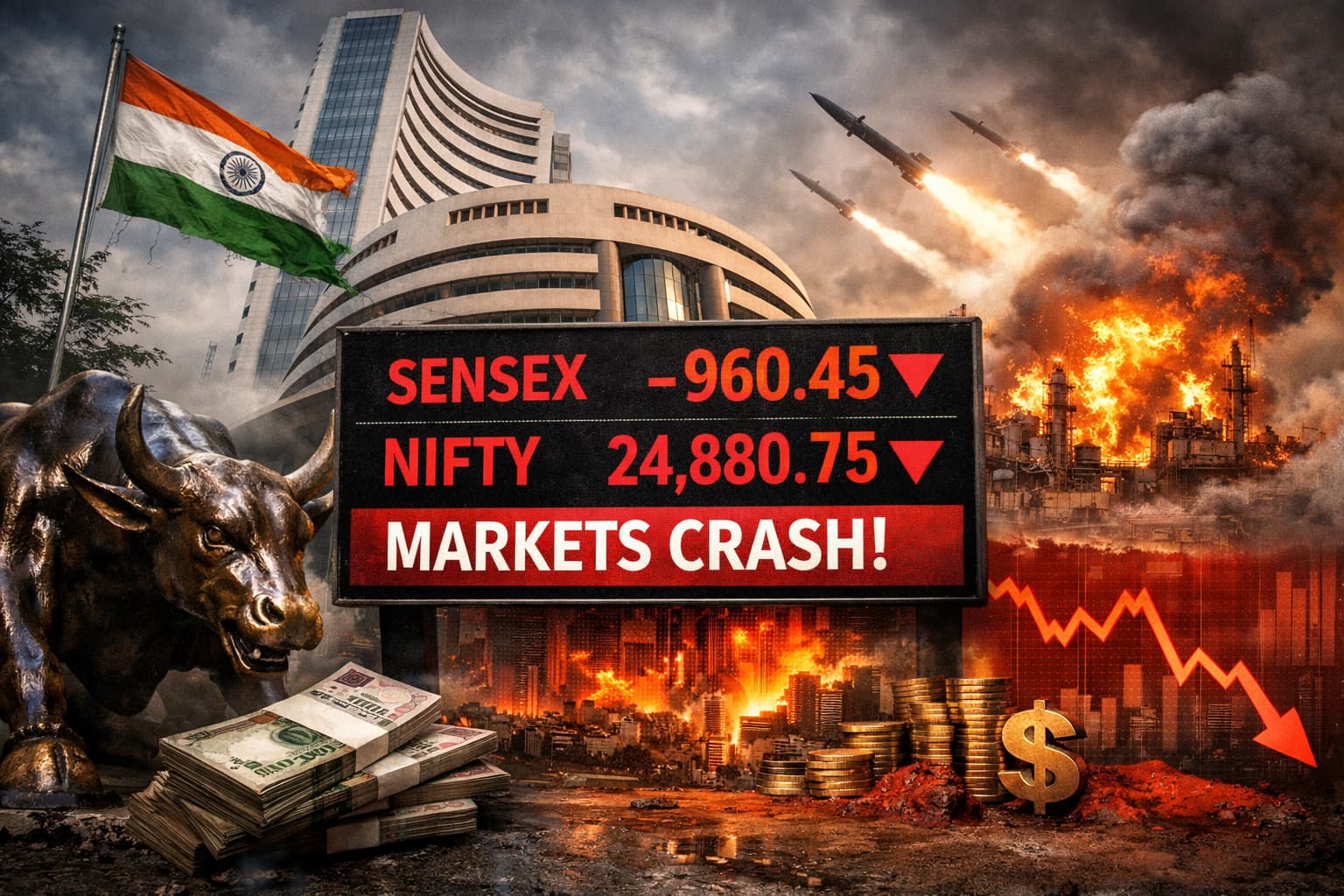
The Nifty and Sensex started off significantly in the red, the first time that they were trading in the downward direction since the battle began on Saturday. At 10: 10 a.m., the BSE Sensex was down by over 960 points, a decrease of about 1.2 per cent. At the same time, the NSE Nifty 50 dropped to below the 24,900 level and dropped by one per cent.
The size of the reduction was drastic. It is reported that investors have lost almost ₹8 lakh crore in market capitalization in the initial few minutes of the trade. Despite the indices recording a small recovery after their early morning lows, the India VIX, which is an index gauging the market volatility, increased by more than 17 per cent, indicating the continuing uncertainty.
Rupee and Global Trends
The local currency experienced the effects of geopolitical tension. The Indian rupee fell to 91.3 against the U.S. dollar, which is a significant drop compared to the previous Friday when the value stood at 91.08. The increased prices of the rupee due to a stronger dollar and an increase in prices make importations expensive to the Indian economy in conventional ways. The stock market in India today was not the only one that had gone down this path.
The bearish mood was reflected on major Asian markets, with Hong Kong Hang Seng index falling 1.5 per cent, Japan Nikkei 225, and South Korea Kospi falling 1 per cent and 1 per cent respectively. Risk is also on the resumption of the market players across the continent as the chances of a more widespread regional conflict increase.
Assassination and Retaliation
The financial crisis is the result of an epic rise in tensions between Israel, the United States, and Iran. Israel and the U.S. launched a combined military operation on Saturday, and this time the intention was to weaken the capabilities of the Iranian government. On Sunday, this operation led to the death of the Iranian Supreme Leader, Ayatollah Ali Khamenei.
The 86-year-old Khamenei had been the main source of Iranian strength since 1989. His death has left a vacuum of power and triggered instant threats of revenge in Tehran. Iran responded in a counterattack with a salvo of missiles on Israel and other nations of the Gulf. The developments came at a delicate crossroad because the tension over the nuclear programme of Tehran was already high.
Even though Iran continues to insist that its nuclear programs are non-violent, Israel has been issuing threats on several occasions that Iran is closer than ever to obtaining a weapon. The U.S has maintained a significant military deterrent off the Iranian coast in recent months to be a security guarantor to Israel.
Economic Fallout and Outlook
Crude oil price is still one of the main concerns of the Indian economy. West Asia is a very important energy center in the world, and any obstruction in the Strait of Hormuz or destruction of oil infrastructure may lead to a spike in the price of fuel. In the case of a country like India, which imports virtually all of its petroleum, that would pose a threat to the rate of inflation and the current account deficit.
According to the analysts, the markets would probably be range-bound and volatile in the coming days. The attention has been completely changed to the foreign headlines and not the domestic corporate income. Investors are set to be reluctant until an indication of de-escalation appears and hoard the cash or switch to gold. The short-term market direction will be based on the reaction of the Iranian leadership to the death of its Supreme Leader and the success of the U.S. and Israel alliance to pursue its offensive actions.
Also Read: AI Fears Shake India’s IT Giants, $47 Billion Wiped Off in Market Rout
Related News

Wipro Rs 15,000 Crore Buyback: Critical Steps to Claim Your 38% Premium
Stock Market in India: India’s leading IT behemoth will initiate its largest capital return progr...

Hero MotoCorp Shares Rise 3% on Historic 100cc Flex-Fuel Launch
Stock Market in India: The Indian largest motorcycle maker (Hero MotoCorp) took a historic leap i...

South Korea Surpasses India to Become World’s Sixth-Largest Stock Market
Stock Market in India: A huge change occurred in global financial markets: South Korea crossed In...