
Market Timing or Market Trap? Understanding the ‘Buy the Dip’ Strategy
Stock Market in India: There is no better phrase used with a lot of confidence in the field of investment than buy the dip. It seems to be one of the shortcuts to wealth that is impossible to argue with: when a stock or a market index falls, it is time to buy cheaply and wait until it naturally starts to go up. The logic may appear to hold a lot of sense, but the fact of the strategy is often a lot more complicated than a mere clearance sale at a store.

 Share
Share
The Logic Behind the Discount
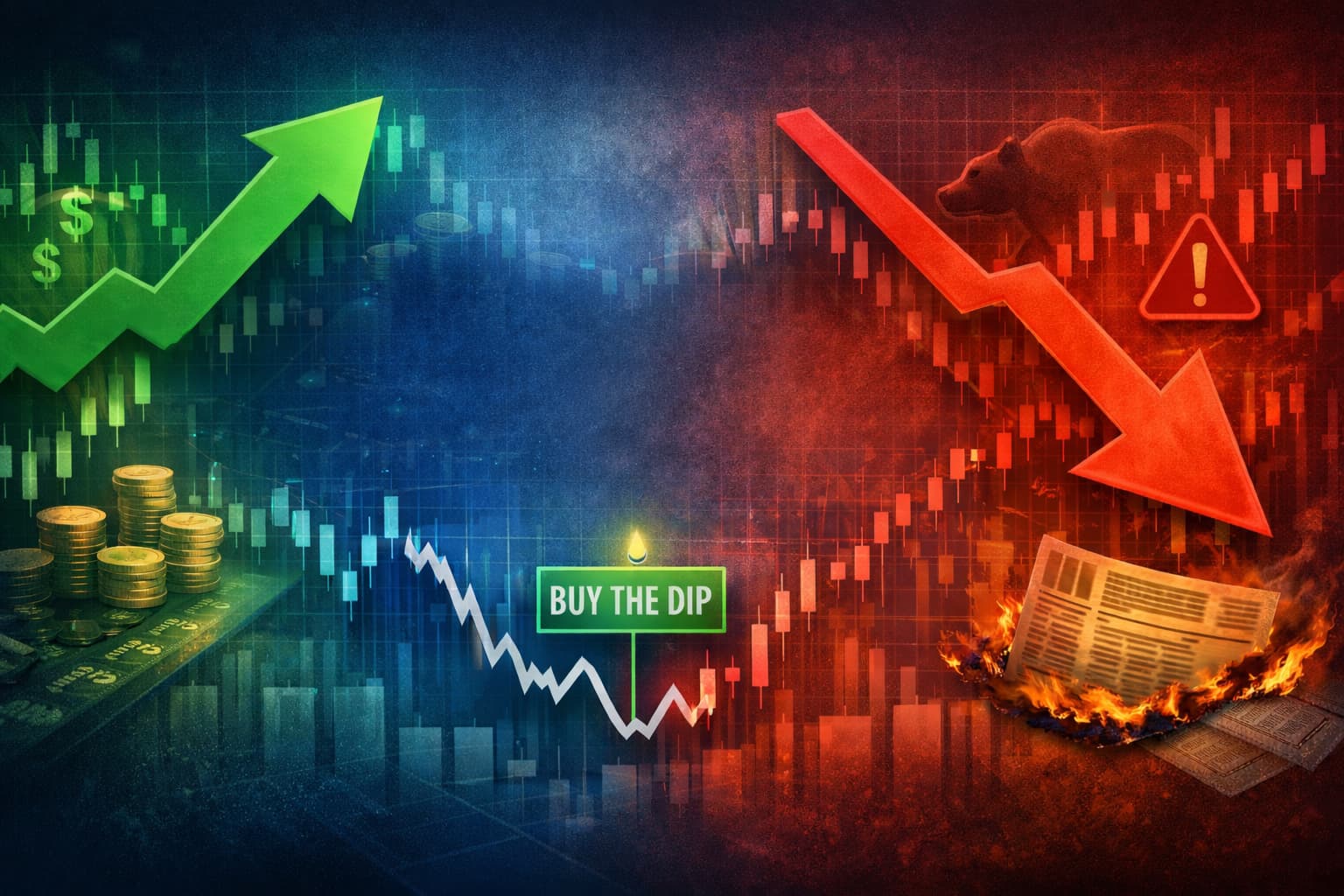
Buying the dip in its basic form is an attempt to capitalize on market volatility. The opposite is true; investors get into positions when prices drop under the assumption that the trend is short-term and that the long-term trend is upward. They lower their average cost of acquisition, thus putting themselves in a higher profit margin as the market stabilises.
This attitude became exceptionally popular after the crash of the COVID-19 market in March 2020. The global markets had a fall at an unprecedented rate during that time, only to be retrieved and hit record highs in several months. The people who possessed the liquidity and the audacity to purchase the dip during the darkest weeks of the pandemic realised lifetime returns. This became a dangerous mental prejudice: the belief that any decline in prices is a guaranteed purchase.
The Trap of Recency Bias
Financial analysts warn that the market of 2020 might have created a false sense of risk for an average investor. This has been referred to as recency bias- the belief that since a certain occurrence took place recently, it is likely to continue happening as well.
However, it is history that shows that not all dips are equal. During a long-term bull, the price usually recovers fast, but in bear markets, a fall of 10 per cent can easily be succeeded by a further 20 per cent. Once an investor buys into a declining market and does not have a clear bottom in sight, he or she runs the risk of being a victim of catching a falling knife. They do not win the discount, and instead, they hold an asset that is going to depreciate over the years.
Structural Shifts vs. Temporary Blips
The main difference that investors should distinguish is that a downturn in prices can be a short-lived event in the stock market in India today, or it can be the start of a long-lasting change in the health of a business. When the stock of a technology giant drops as a result of some kind of panic in the market, it can be a serious “dip.” But when the price drops due to the business model of the company becoming obsolete or the company having its debt spiral, it is not a dip, but a devaluation.
The Japanese Nikkei 225 index provides a blemishing historical example. However, the market came to a long-term decay starting in 1989, which took decades. Even an investor who purchased the dip in 1992 and thought that they had gotten a bargain would have had to wait almost three decades to break even.
Strategy Over Instinct
To the normal retail investor, it is statistically improbable that the effort to predict the exact bottom of a market move will be successful. A vast majority of successful wealth-generating plans are not time-based but consistent.
Among them is Dollar Cost Averaging (DCA). Instead of waiting till there is a crash to inject a large amount, investors will buy a given amount at set intervals, regardless of the price. This will automatically lead to buying more when the price is low and selling when the price is high, which is basically buying the dip without the pressure of looking at the charts all the time.
The Bottom Line
Purchasing the dip requires two things, which are often in short supply: easy-to-find capital and emotional restraint. The experience of a portfolio going down is traumatic; it is even more challenging to pour more money into the same portfolio when it is panicking. The strategy can make gains fast, but the strategy needs a deep insight into whether one will be buying a setback or a decline that is irreversible. The failure to have a long-term outlook and a diversified portfolio can easily turn buying the dip into a risky bet.
Also Read: Indian Markets Set for Positive Start as Global Tech Rally Boosts Sentiment
Related News

Wipro Rs 15,000 Crore Buyback: Critical Steps to Claim Your 38% Premium
Stock Market in India: India’s leading IT behemoth will initiate its largest capital return progr...

Hero MotoCorp Shares Rise 3% on Historic 100cc Flex-Fuel Launch
Stock Market in India: The Indian largest motorcycle maker (Hero MotoCorp) took a historic leap i...

South Korea Surpasses India to Become World’s Sixth-Largest Stock Market
Stock Market in India: A huge change occurred in global financial markets: South Korea crossed In...