
Unpacking the New US-India Interim Trade Deal
Business News Today, New Delhi — After many months of interrupted economic relations and growing tariff issues, India and the United States have finally sealed an interim trade agreement. The announcement, which was made earlier this week, provides some relief to some of the sectors but elicits serious concerns in other areas, casting some uncomfortable questions on the strategic autonomy of India and the future of its agricultural core. As the government authorities consider the agreement a breakthrough to an end to a history of enmity, critics and experts in the industry can study the fine print and find a field of pure trade-offs.

 Share
Share
The Economics of “Reciprocity”
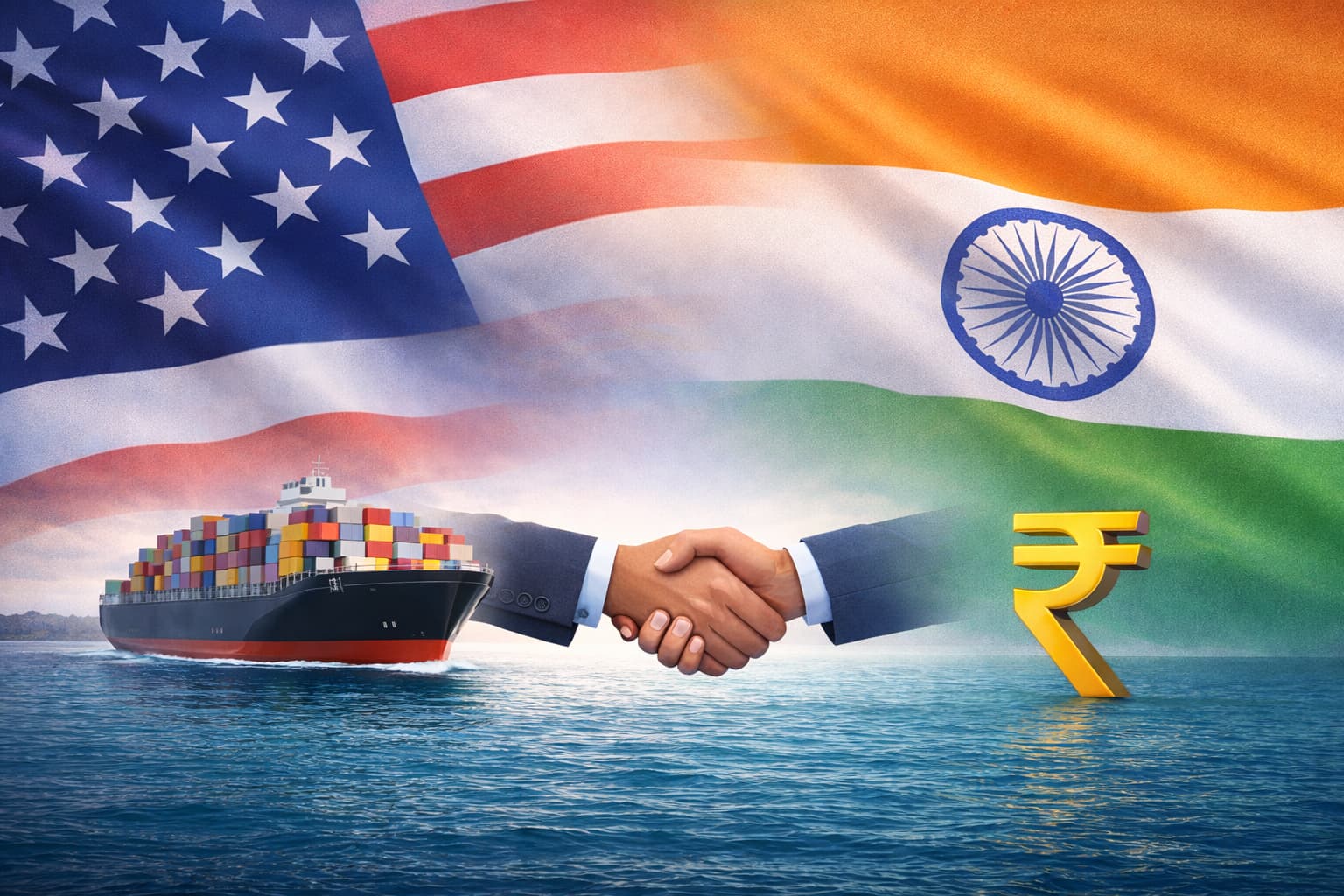
The fundamental part of the agreement is a significant decrease in the tariffs in America. The United States has agreed to reduce its taxes on Indian imports from 50 percent to 18 percent. India, on the other hand poised to reduce obstacles to many American industries’ goods and agricultural products.
On the surface, the setting seems to be quite conventional in terms of reciprocity. But the terms that accompany this relief are great. India has also shown a desire to buy 500 billion worth of U.S. energy products, aircraft, precious metals, and technology within the next five years. This is a significant undertaking that is set to offset the trade surplus that is currently enjoyed by India with the United States- something that has been a thorn in the flesh of American negotiators.
The disparity has not taken long to be pointed out by critics. According to P.Chidambaram, former Finance Minister, in an article in the Indian Express, the deal does not truly have reciprocity. He termed the result as relocation of the mountain to get the mouse, implying that the negotiators of the Indians gave a lot more than they took. This feeling is shared by trade analysts who observe that although the U.S tariffs are declining, they are still very high as compared to the pre-dispute rates of approximately 2.5 percent.
Sovereignty and the Oil Question
Perhaps the most debatable part of the deal is outside the field of ordinary business. The deal is also reported to contain an obligation of India to no longer import Russian crude oil, one of the foundations of India’s energy security policy, due to the onset of the Ukraine conflict.
To make sure compliance is achieved, the Trump administration has not yet ceased the right to reimpose punitive tariffs in case India returns to these purchases. This provision has raised a heated debate on national sovereignty. Writing in the Deccan Chronicle, Pavan K. Varma cautioned that it would be dangerous to set the precedent that a foreign state will dictate how to source energy. He described the arrangement as a direct challenge to the strategic independence of India. He said that spying by a U.S. committee is practically equivalent to foreign oversight.
The implications are far-reaching. Throughout the decades, New Delhi has boasted of its independent foreign policy, conducting trade with allies, not on bloc politics, but on national interest. The new deal places India in a risky position of balancing on both sides by conditioning trade relief on foreign-policy alignment.
For the latest business news daily, keep visiting daily info.
Agriculture: A Tale of Two Sectors
The effects of the accord are the most acute in the massive Indian agricultural industry. The structure has created a distinct division between beef producers and farmers.
In the case of the animal-hunger industry -poultry, dairy, and fisheries- the deal is considered pretty much a win. The American red sorghum and distiller’s dried grains with solubles (DDGS) imports opening will provide the availability of cheaper and high-quality feed. This can enhance the margins without disadvantaging domestic producers, since the feed is a significant expense in poultry and fish farming, since India has not conceded on the importation of final dairy or poultry products.
The image is, however, much bleaker to crop farmers. An editorial team of The Indian Express focused on the high productivity inequality that would be a disaster for the Indian growers who would face the American competition. To use the example of apple production in Washington State, there is an average yield of more than 48 tonnes per hectare. Conversely, in Jammu and Kashmir, the yield is approximately 12 tonnes, and in Himachal Pradesh, 5 tonnes only.
The farmers of maize and soybean in India are not given a level playing field with their American counterparts, who have access to the same genetically modified seeds and high-tech equipment. There is clearly felt of the infiltration of cheaper U.S. grains into the local market and the decrease in prices, which would destroy the livelihood of a sector already in a state of distress. The uncertainty over whether or not the tariff-sensitive cereals will be under the protection has just contributed to the anxiety.
Also Read: New Inflation Series in India, January CPI at 2.75%
Related News

Jan Dhan Yojana Crosses 58 Crore Accounts, Boosting Financial Inclusion in India
Business News Today: India has had the occasion to observe history being made as the Pradhan Mant...

SEBI Bans Rajesh Exports CMD Over Alleged Financial Irregularities
Business News Today: SEBI hit the Chairman and Managing Director of Rajesh Exports with hefty fin...

Byju’s Tragedy: How Absolute Success Ruined a $22B Empire
Business News Today: Byju’s is a modern-day corporate tragedy, the rise of the Indian ed-te...