
Musk Shifts Focus to Moon City Now
Tech News Today: SpaceX aims at a self-expanding lunar base in ten years as IPO approaches and changes course.

 Share
Share
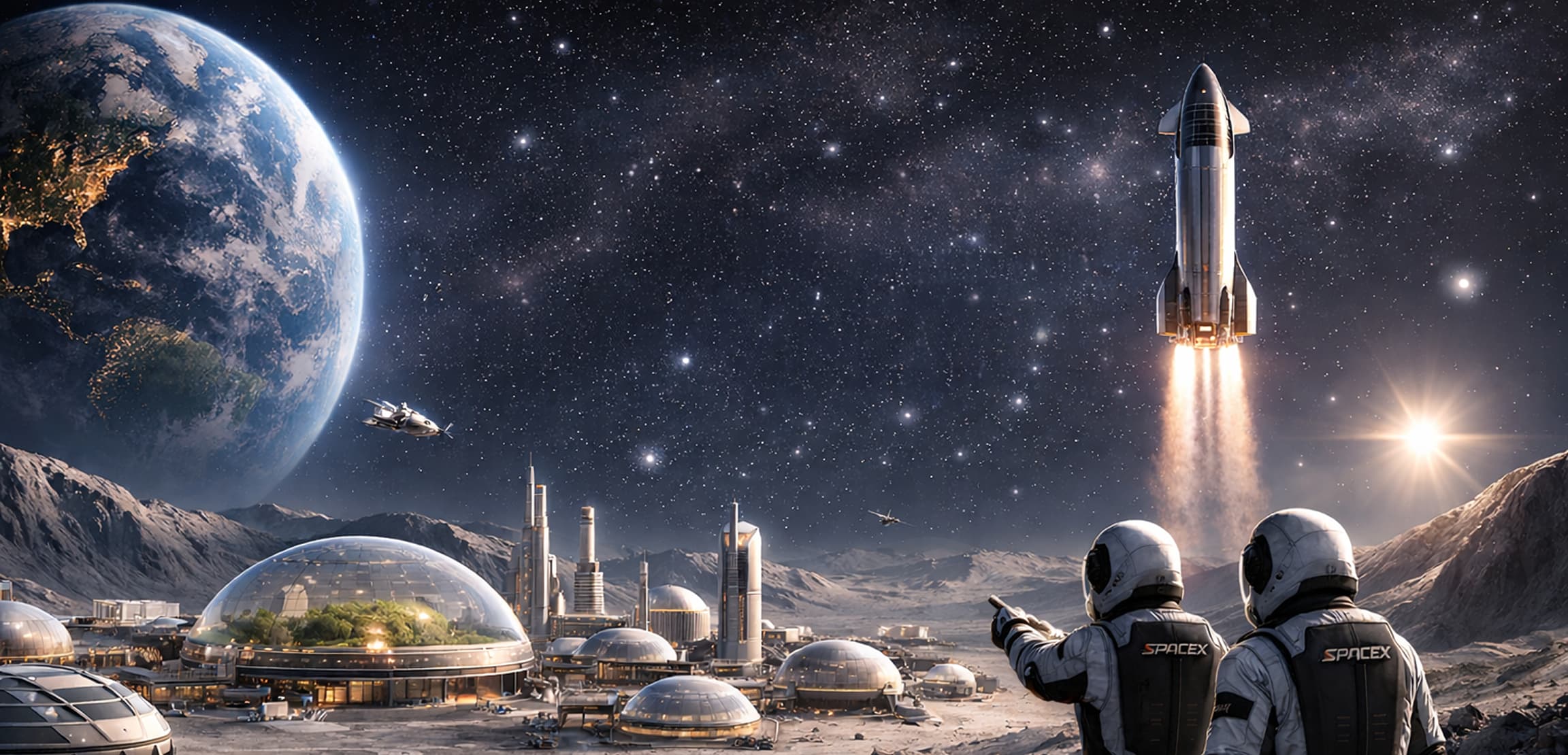
Elon Musk has recently announced in an interesting strategic realignment of the company that SpaceX would now focus on building a self-expanding city on the moon, replacing its long-standing goal of settling Mars. The billionaire businessman has suggested that it is a lunar colony which could possibly be made within less than a decade, thus distancing himself from his previous suggestion that Mars was the imperative of the first order in making humanity multi-planetary.
Musk conveyed this decision to change the priorities through a series of internal communications and social media messages this week. Even though Mars remains the end destination, the Moon has been seen as the necessary stop on the way to saving the future of the civilization in a very short period of time.
The Logic Behind the Pivot
It seems that the choice is based more on logistical and engineering factors. Musk has stated that the Moon has a much easier development cycle: a trip to the Moon does not take much longer than a three-day excursion, but a trip to Mars requires at least six months. In addition, the position of the heavenly spheres between the Earth and Mars allows launch openings every 26 months.
Musk wrote that the company could take off to the Moon every ten days. We are therefore able to repeat the process with a significantly increased speed in order to finish a city on the Moon rather than a city on Mars.
Focusing on lunar missions, SpaceX will be able to test and perfect its technologies without having to face the delays characteristic of Martian missions. In case of failure of a system on the Moon, help or spare parts can be sent within days, as opposed to years. This plan of the Moon is consistent with the Artemis program of NASA, which has already contracted SpaceX to land astronauts on the lunar surface.
A “Self-Growing” Industrial Hub
The concept of a self-expanding city does not only refer to dwelling. Musk has a vision of an industrial base capable of expanding itself using the local resources. During an interview with his employees at xAI, his artificial-intelligence corporation, which is currently in the process of merging with SpaceX, Musk described a vision of the future. He proposed the building of a lunar factory that will focus on the production of AI satellites.
It has been reported that the facility would contain a so-called mass driver, an enormously large catapult that would send satellites into space without using rocket fuel. Inasmuch as this idea is scientific fiction, it is supposed to support a huge scale of space-based data centres. According to Musk, the space environment offers a more appropriate environment for the high-energy demands of advanced AI.
The xAI and SpaceX will be integrated, meaning that the city on the moon will be highly automated. Most of the significant work will be carried out by robots and autonomous systems that will build infrastructures before a large group of people comes.
Keep reading Daily Info articles for the latest tech news!
Corporate Shake-ups and IPO Plans
The turn of strategy takes place in the turbulent times of Musk. SpaceX has an eagerly awaited initial public offering (IPO), which could be as early as June 2026. The firm, along with xAI, is now worth more than $1 trillion.
However, there are no barriers on the way. It has been reported that some of the co-founders of xAI have recently left or resigned their positions in the company. These exits are overlapping with the attempts of Musk to combine the AI startup with the rocket venture. These developments are under heavy scrutiny by investors. The prospect of a lunar city can be used to create hype and a reason to warrant a high valuation before the IPO.
Analysts consider that the merger is a consolidation of resources. SpaceX needs high-end AI to assist its self-driving rockets and a possible robotic workforce, whereas xAI needs the ability to launch its equipment into space. The Moon is, therefore a perfect testing ground for the two entities.
The Race for the Moon
SpaceX is not the only player to visit the moon. The Blue Origin of Jeff Bezos has long been a supporter of the heavy industry of space and the Moon colonization. Over several years, the two companies have traded insults concerning their conflicting philosophies, where Musk was a proponent of Mars and Bezos a proponent of the Moon. At this point, their paths seem to be converging.
Further, there is a geopolitical urgency. The US is engaged in a fierce competition with China to revisit the moon with human beings. China has also been on a fast track with its lunar program and hopes to have a man-landing by 2030. Musk is US-national security and foreign-policy aligned by placing more importance on the Moon to bring SpaceX to the level of its interests. The presence of the American army on the Moon would be a strategic point in the Moon.
Also Read: Google Ends Security Updates for Android 12 or Older, Malware Threats
Related News

Samsung Unveils Galaxy S26 Series in India: A New Era of Proactive AI
Tech News Today: India Samsung has officially released its Galaxy S26 series in India, the third ...

Google Flow is now with Nano Banana and More Features
Tech News Today: Google has formally reopened its AI-based creative studio, Flow. The substantial...

Top Parental Control WiFi Routers for 2026
Tech News Today: Digital environment as a modern family has come to a stage where it is almost im...